Wednesday, 9 May 2012

May Day Weekend in Dungeness

My annual long weekend to Dungeness Bird Observatory looked a bit daunting with the bad weather, but arriving on Thursday afternoon the forecast for Friday looked reasonable, so David, the Assistant Warden (AW), and myself set up the nets in the Trapping Area ready for the next day.

Getting up at 4.30am and staggering across the shingle I was hoping for a reasonable catch of 50 birds for the day, with the possibility of something exciting included.  The first round of the Trapping Area produced 15 birds and on returning to the observatory, warden David (very confusing being both Davids) had caught a Nightingale (below) in the Heligoland trap whilst erecting the two moat nets. 

Whilst I was ringing my birds, David checked the two moat nets and to our surprise brought back nearly 20 birds!  This was to be the start of one of the biggest spring falls known to occur at Dungeness.  We were joined by AW David and he and myself went back to the Trapping Area bringing back nearly 40 birds and this continued right up to the end of the day, by which time we had ringed 319 birds of 19 species!  This included 125 Whitethroat, 107 Willow Warbler (including three of the acredula subspecies), four Redstart, nine Chiffchaff, two Swallow, 14 Garden Warbler (plus a French ringed bird), four Sedge Warbler, 27 Blackcap, a Pied Flycatcher, a Lesser Whitethroat, six Spotted Flycatcher, a Wood Warbler and a Redpoll!
Willow Warbler - Acredula subspecies (northern race)

Wood Warbler

Pied Flycatcher - First year female

Redstart - very difficult to age female!!

Across the observatory area for the day the most abundant species were Whitethroat and Willow Warbler with estimates of around 1000 and 800 respectively along with 65 Wheatear (including many Greenland subspecies), 50 Garden Warbler and 150 Blackcap whilst more unusual species were represented by two Marsh Harrier, three Hobby, a Merlin, two Short-eared Owl, four Turtle Dove, three Cuckoo, three Nightingale, 20 Redstart, eight Whinchat, two Ring Ouzel, two Redwing, eight Lesser Whitethroat, ten Spotted Flycatcher and five Pied Flycatcher. There was also a steady passage of birds overhead with 60 House Martin, 350 Swallow, 13 Tree Pipit, 30 Yellow Wagtail and 30 Redpoll.  This truly paid homage to 'May 4th be with you'!

The rest of the weekend dropped to rubbish conditions and although the heligoland trap managed to add just into double figures for each day these were almost certainly birds that were left over from the Friday, but I did manage to see a Wryneck on Saturday morning and missed the Red-rumped Swallow on that evening.  The weekend was kept flowing by the company of the regular May Day weekend group, food and more food and a certain amount of alcohol......thanks a lot guys for a great weekend.
Me and my Pied Fly (David Walker)

As is always the way, 30 mins after I left on Monday I got a call that a Crested Lark had been found!  I struggled to resist the urge to turn back, but was now very ready for sleep!

Weather Stops Play!!

The wet and windy weather over the last three weeks has made it almost impossible to find decent conditions for any ringing.  Nests have now started to increase much more and I have now found in my garden nests of Song Thrush, Blackbird, 2 Robins, Blue Tit, 2 Great Tit, Dunnock, Wren, Goldcrest, Woodpigeon, Jackdaw and today confirmed a Linnet nest!  This is the second Linnet nets that I have had in my garden with the first in 2008 and in exactly the same spot outside my French doors!  One of the Great Tit nests was ready to ring today and the Blackbirds I ringed last week, but on returning from a weekend away, found the nest had been predated with bits of young Blackbird all over the garden!!  My bet is on a semi feral cat belonging to my neighbour.  Whilst locally to my house another two Tawny Owl nests were ringed, one with three chicks and one with one.

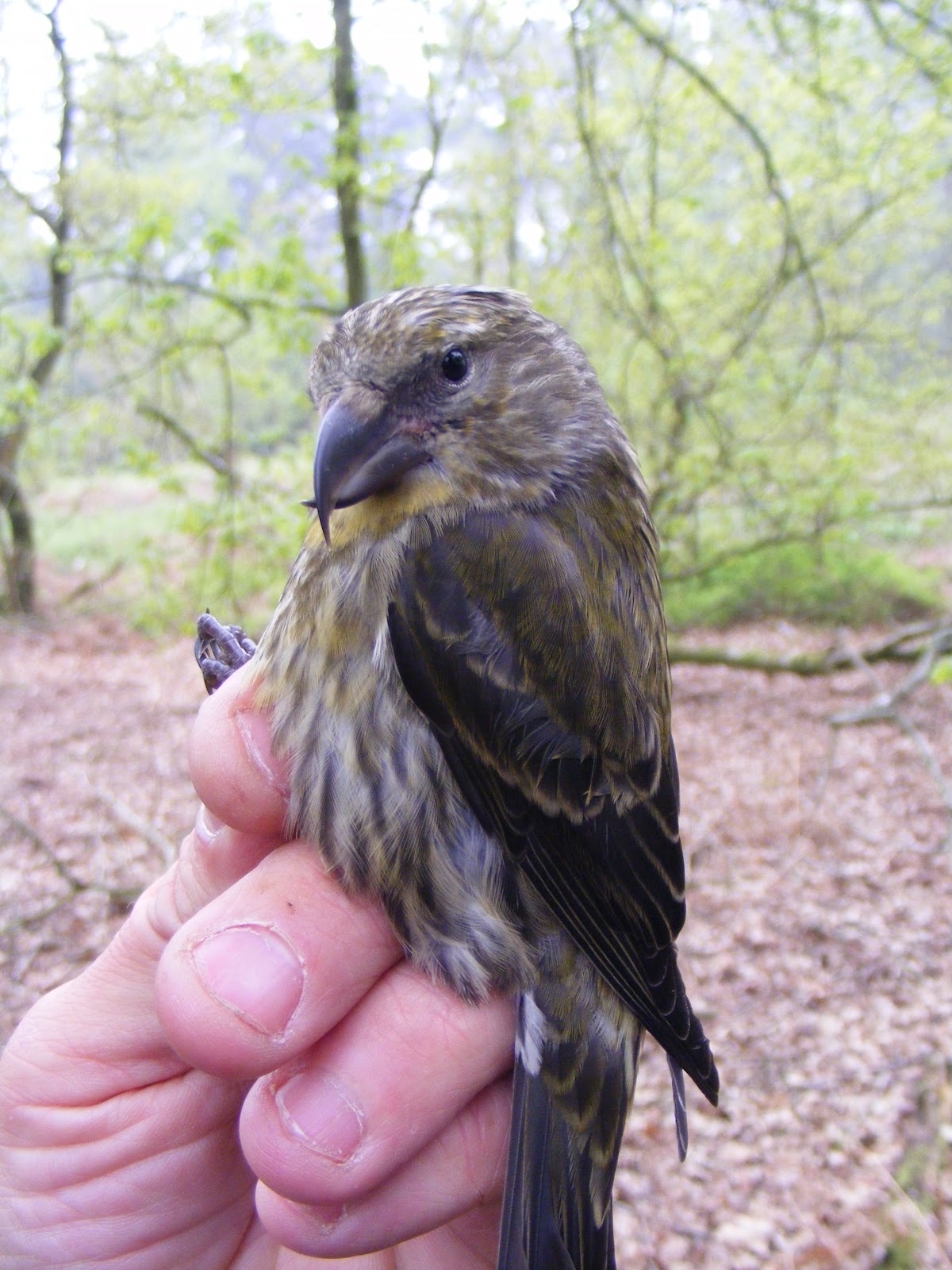
I have only managed to do one netting session at Leith Hill which was quite rewarding, with highlights being two Blackcaps, ten Siskin (including my first juvenile - above), four Crossbill (including a very juvenile bird - below), five Willow Warbler, a Nuthatch and three Blackbird.
Crossbill juvenile - note the heavy streaking across the whol plumage


Crossbill juvenile - a couple of replaced feathers in the face and on the breast may be the start of post juvenile moult

Crossbill juvenile - note pale tipped greater coverts

Crossbill juvenile - note streaked dull rump

Of the 13 other Siskin caught on this day, one was a control which had originally been ringed barely 2km away at South Holmwood in late March this year.

Birds ringed:

Tawny Owl - 4 nestlings
Crossbill - 4
Siskin - 10
Dunnock - 3
Blackcap - 2
Blue Tit - 1
Robin - 2
Chaffinch - 3
Willow Warbler - 5
Chiffchaff - 1
Nuthatch - 1
Great Tit - 8 nestlings
Blackbird - 3 + 4 nestlings

Saturday, 21 April 2012

The Garden, more Crossbills, recoveries and a thank you to Rex!

A short morning session at home produced just ten new birds - a Great-spotted Woodpecker, four Goldfinch, four Blue Tit and the best an adult Rook (below top)!  This is the first full-grown Rook that I have ever caught and what a fabulous bird it is in the hand.  Whilst the latest session at Leith Hill produced 15 new birds including three more Crossbill, two Siskin, two Willow Warbler and an adult male Brambling (below bottom).

I have also just received a large series of recoveries, 24 to be exact, which unsurprisingly involved a good number of Redpolls, but also a few unexpected gems!

Mallard

GR16961 - ringed as an adult female at Holmwood Common on 23rd Jan 2011 and was taken into care from Dorking, 2km away, on 14th March 2011 with a fractured leg, but didn't survive its injuries.  My first Mallard that hasn't been recovered as having been shot!

GC78000 - ringed as a juvenile at Warnham LNR on 20th July 2011 and was shot 11km away on 29th Jan 2012 near Forest Green, Surrey.

Chiffchaff

DNK266 - ringed as a juvenile at Warnham LNR on 9th July 2011 and 31 days later it was caught at Queen Mary Reservoir, Surrey 41km away to the NNW on 9th Aug 2011.

Blue Tit

Y169484 - ringed as a juvenile at Warnham LNR on 6th Aug 2011, this bird was found dead in 2km away in Horsham having hit a greenhouse window only a couple of months later on 11th Nov 2011.

Great Tit

TR91666 - ringed as a nestling at Warnham LNR on 6th May 2011, this bird was taken by a cat in Horsham just 54 days later in Horsham on 29th Jun 2011.

Magpie

EG15741 - ringed as a juvenile in my Warnham garden on 2nd Oct 2010, it was then found dead 20km away at Thakham, near Pulborough, West Sussex on 16th Jun 2011.  This is my first recovery of this species.

Goldfinch

L757852 - ringed on 23rd Mar 2011 at Leith Hill and caught a fortnigfht later on 6th Apr 2011 9km away at Gomshall.

Redpoll sp.

L032848 - ringed as a 1st year male on 25th Sep 2011 at Whitwell, Derbyshire and caught 245km SSE at Leith Hill on 9th Jan 2012.

L054653 - ringed on 13th Mar 2011 at Tandridge, Surrey and caught 25km WSW at Leith Hill on 23rd Jan 2012.

L758275 - ringed as a 1st year bird at Capel on 6th Apr 2011 and caught at Beare Green as an adult male on 1st Feb 2012.

L771690 - ringed as a 1st year male on 6th Aug 2011 at Newton, Lancashire and caught at Leith Hill on 9th Jan 2012 as an adult male 339km SSE.

Y324767 - ringed on 21st Oct 2011 at Leith Hill and caught at Dungeness, Kent on 10th Nov 2011 97km ESE (map below).

Y324802 - ringed as a 1st year on 27th Oct 2011 at Leith Hill and caught at Capel on 11th Nov 2011, 3km SE.

Y324823 - ringed as a 1st year on 27th Oct 2011 at Leith Hill and caught at Icklesham, East Sussex on 1st Nov 2011 79km ESE.

Y324883 - ringed as a 1st year male at Leith Hill on 29th Oct 2011 and caught at Capel on 11th Nov 2011.

Y439009 - ringed as a 1st year on 30th Oct 2011 at Icklesham, East Sussex and caught at Leith Hill on 28th Nov 2011.

Y443956 - ringed as a 1st year at Queen Mary Reservoir, Surrey on 29th Oct 2011 and caught at Leith Hill on 16th Nov 2011.

Y469533 - ringed as a 1st year at Capel on 21st Oct 2011 and caught at Leith Hill on 16th Jan 2012, 3km NW.

Y469682 - ringed at Capel as a 1st year on 8th Nov 2011 and caught at Leith Hill on 9th Jan 2012.

Y469779 - ringed at Capel on 19th Nov 2011 as a 1st year and caught at Leith Hill on 23rd Jan 2012.

Lesser Redpoll

L484304 - ringed as a 1st year on 10th Oct 2010 at Slaley, Northumberland and caught as an adult female at Leith Hill on 29th Jan 2012 430km SSE (map below).

X786799 - ringed as a 1st year male on 30th Jan 2011 at Penrith, Cumbria and caught at Leith Hill on 29th Jan 2012 as an adult male, 421km SSE.

Y324719 - ringed as a 1st year on 21st Oct 2011 at Leith Hill and caught on 22nd Nov 2011 at Capel, 3km SE.

Siskin

Y169992 - ringed as a first year female at Capel on 13th Oct 2011 and caught at Leith Hill on 9th Jan 2012.

Just as I was writing this post I got a call from my colleague Ruby at Leith Hill saying that her German Shepherd dog Rex had found a big fluffy chick in a patch of brambles whilst walking near her house.  So I dashed over and found this little guy stuck in the brambles:
Tawny Owl chick
A large oak tree standing over this bramble patch looked like the obvious place of origin, so Ruby and I dashed back to the workshop to get a ladder whilst Simon kept the bird warm.  Climbing the tree an old butt of a broken limb turned out to house a snug nest and a further two chicks (Ruby and Simon with nestlings below).  They were quickly ringed and put back in the nest and about five minutes later the heavens opened!  A lucky break that Rex found the chick as it would have got drenched and probably not survived, well done Rex!
Birds ringed:
Goldfinch - 6
Blue Tit - 4
Siskin - 2
Brambling - 1
Great Tit - 2
Chaffinch - 1
Willow Warbler - 2
Wren - 1
Great-spotted Woodpecker - 1
Blackbird - 1
Rook - 1
Crossbill - 3
Tawny Owl - 3 nestlings

Saturday, 14 April 2012

CROSSBILLS!!!

In the last week and a half I have done two sessions at Leith Hill which has probably seen the last of the Redpolls with just ten caught including one control and one retrap.  Whilst the first session produced no Siskins at all, the second produced 11 new, which were all 1st year males, and six retraps of which just one was female.  From this I can only imagine that the females are busy sitting on eggs and although fledglings have been seen elsewhere already none have been seen here yet.  Other catches new birds here included four Chiffchaffs, the first Blackcap, the first four Willow Warblers and a Brambling (below), but the highlight was 11 Crossbills.
Finally, after 16 months of watching them flying around the tree tops above my nets we have finally managed to catch Crossbills!  What a magnificent creature they are, even if they are a bit of a challenge with ageing and sexing.  Firstly, what species are they?  The three species of Crossbill that occur in Britain (Parrot, Scottish and Common) are all very tricky to tell apart as they are very similar so after a series of head and bill measurements were taken they were all within Common Crossbill, phew!  Then, what age are they, well because Crossbill can breed so early in the year (fledging as early as December or January)  normal rules don't necessarily apply because they can have two moults in one year.  If they have bred early then a first partial moult after breeding takes place by both juveniles and adults early on and the replacement feathers whether male or female will be greeny/yellow in colour.  Then in the late summer early autumn adults complete their full post breeding moult and juveniles complete their post juvenile moult with these feather colours being red for males and greeny-grey for females.  Sounds complicated but I hope this makes sense!  The following photos show some of this:

1st year juvenile Crossbill (3J):

Large amount of feathers around head replaced with new greeny/yellow ones, but streaky grey juvenile feathers still present also.


Rump still streaked with a few greeny/yellow feathers replaced above tail coverts, no unmoulted greater coverts and fresh looking flight feathers


Most body feathers replaced on underside with new greeny/yellow feathers but still a number of streaked juvenile feathers present.

1st year juvenile Crossbill (3):

This particularly yellow bird seems to be a more advanced juvenile than the previous bird in that it has undergone more of a partial moult.  Tiny flecks of juvenile plumage can just be seen on head, rump and undersides, but no moult in greater or median coverts and still fresh flight feathers.
A clear wing contrast between the particularly yellow 1st year bird and a 2nd year female.  Also note the bleaching of the tips of the 2nd year bird which shows that these feathers are a lot older than the unbleached 1st year.

2nd year female Crossbill (5F):


This was one of two birds that had a particularly orange overall plumage with the exception of the mantle and wing feathers which were green. The moult limit in the greater coverts showing contrast between six adult and four juvenile feathers gives away that this is a bird born in early 2011, whilst the highly developed brood patch shows it to be a female.


The rump in this photo is particularly orange in colour and contrasts completely with the green mantle.
2nd year female Crossbill (5F):
In contrast this is a more regular greeny/grey female, still showing the contrast in the greater coverts.
2nd year male Crossbill (5M):
A really good example of a bird that was born in very early 2011 having done a partial post-juvenile moult in the spring which is the greeny/yellow feathers on head and collar and then completed this moult in the autumn with the array of red feathers being a male, but still retaining some of the juvenile greater coverts.

Variation in feather colouring also shown in this photo of its rump and a few of the new greater coverts can be seen with a red edge rather than green. 
An interesting additional observation was that the mandibles of the cross bill didn't seem to follow a rule, in that some top mandibles crossed to the left while others to the right.

Other ringing over this period included a couple of mornings in my garden which produced 37 new birds including seven Goldfinch, seven Greenfinch, a Coal Tit (unusual here for this time of year), two Chaffinch and a Blackcap (below).
This week also saw my first nestling ringing with a nest of three Blackbird by my office (below).
Birds ringed:
Lesser Redpoll - 4
Redpoll sp. - 4
Goldfinch - 8
Brambling - 1
Blackcap - 2
Blue Tit - 17
Chaffinch - 3
Dunnock - 2
Great Tit - 4
Coal Tit - 1
Siskin - 11
Crossbill - 11
Blackbird - 3 nestlings
Song Thrush - 1
Chiffchaff - 4
Willow Warbler - 4
Long-tailed Tit - 1
Greenfinch - 7

Sunday, 1 April 2012

Kites, long bills and the first warblers

The last couple of weeks has seen an eruption of Red Kite sightings over the Leith Hill area with up to 25 individuals passing through on spring migration, whilst the first Chiffchaff, Willow Warbler and Blackcap have arrived back from Africa.  Also seen was a Ring Ouzel and a Stonechat at Coldharbour cricket pitch thanks to Ray Smith and Derrick Robinson.

Ringing at Leith Hill was done in three sessions with two visits to the heath and a demonstration to the Working Holiday volunteers at Henman Bunkhouse.  The two prior produced another 80 new Redpoll, but a definite change has occurred with Lessers hugely dominating the catch and the last session on 25th involved not a single retrap showing migration was fully underway.  One of these Lessers was sporting an absolutely huge bill (below top).  Other species caught included six Siskin, four Chiffchaff, a Blackbird, a Song Thrush and four more control Redpoll!  A number of the Chiffchaffs caught had a lot of olive pollen stuck to their face where they had been feeding on the nectar as a valuable food source on their migration whilst around the Mediterranean (below bottom).
Whilst the visit to Henman Bunkhouse produced just ten birds which included a Siskin, a Marsh Tit (below by Paul Stevenson), two Treecreeper, two Goldcrest and two Chiffchaff.
Marsh Tit - note the pale spot at the base of the upper mandible which is the
clincher for me in separating from Willow Tit which has an all black bill
The two visits to North River were both productive with twelve new birds on each visit which included four Goldcrest, seven Chiffchaff, a Treecreeper, a Redwing, 2 House Sparrow (below top) and a Great Spotted Woodpecker.  The latter two were new species to be caught for this site and another new species was added with a control Goldfinch (below bottom) having been ringed in my garden last October.  This Goldfinch was also sporting a rather large bill.

After having consistently heard Bullfinch on our visits to North River we finally caught our first (below), but unfortunately this bird had a big case of scaly foot (a virus that creates huge growths on the legs mainly seen in Chaffinches) so obviously couldn't be ringed.

Birds ringed:
Lesser Redpoll - 49
Redpoll sp. - 24
Common Redpoll - 7
Siskin - 7
Great Tit - 3
Chaffinch - 1
Marsh Tit - 1
Blue Tit - 2
Robin - 1
Wren - 5
Goldcrest - 6
Chiffchaff - 13
Treecreeper - 3
House Sparrow - 2
Blackbird - 2
Great Spotted Woodpecker - 1
Redwing - 1
Song Thrush - 2

Sunday, 18 March 2012

Spawk, first breeding and a large batch of Recoveries

The last three weeks on Leith Hill has seen the end of winter and the start of spring with breeding activity seen from at least 40 species. The highlights being the Woodlarks back displaying, Crossbills with young and the Woodcocks have been displaying since 27th February which is amazingly early! Ringing here has seen a steady decrease in new Siskin and Redpoll down to just 13 on 6th March, but on 14th March this reversed with 76 new birds caught - spring pasage? The Redpoll species have also reversed back to larger numbers of Lesser than Common. Redpoll controls keep coming in with seven in this period including six on 14th March - Y437322, Y435633, Y244305, Y708145, Y703518, Y703704 and Y043936! Siskins have also increased in number with a number of females showing the early stages of brood patches, so an early breeding season for them certainly seems on the cards. The only other species caught of note were five Redwing (not caught any here since January and a stunning male Sparrowhawk (below), whilst notable sightings have included a Red Kite, a Goshawk and the first Chiffchaff on 16th.

I have mentioned before about the huge variation in the 'poll' colour on the Redpolls from a dark purple to fiery yellow or even not coloured at all, but an adult male Common Redpoll caught on 14th March was very unusual. The poll was orange in colour, but this also was the case for all the other areas that a male displays the normal red in the cheeks, breast, throat and rump (below).
If this was not all the tail feathers were strange too in that they had an unusual amount of white on each feather, especially on the inner webs (below top).
A combination of bad weather and other commitments meant that I have only managed a single ringing visit to North River which saw our best catch so far of 33 birds (19 new, 13 retraps and one control). The new birds included another four Robin, Song Thrush, Long-tailed Tit and two new species a Chaffinch and two Greenfinch (below) whilst the control was a first year female Great Tit that had been ringed nearly 7km away at Capel in September last year. The afternoon was spent doing an amount of habitat work laying a large section of overstood blackthorn which should really benefit the birds in the summer for both nesting and food. Sightings here included a Barn Owl, three Crossbill, four Skylark, Greylag and Canada Geese and most surprisingly a pair of Tufted Duck flew high down river!
A brief session in my garden on 25th February caught me 33 new birds as usual mainly Blue Tits and Great Tits, but also included a Coal Tit, two Goldfinch and a Great Spotted Woodpecker. Whilst a quick check of a neighbouring nestbox resulted in ringing an adult Stock Dove.

A large batch of recoveries have also come through, as follows:

BLUE TIT - X896793
ringed 27/12/09 Steyning, Sussex
caught 27/2/11 My garden - 427 days, 25km N

GOLDFINCH - L614106
ringed 15/5/11 Crowborough, Sussex
caught 2/10/11 My garden - 140 days, 35km W
GOLDFINCH - L629593
ringed 28/10/10 Gomshall, Surrey
caught 6/11/10 My garden - 9 days, 15km SSE

SISKIN - L867948
ringed 25/5/11 Llwynmawr, Wrexham
caught 22/8/11 Leith Hill - 89 days, 273km SE
SISKIN - X403389
ringed 5/5/09 Slalery, Northumberland
caught 30/11/11 Leith Hill - 939 days, 430km SSE

LESSER REDPOLL - L794934
ringed 11/3/11 W Horsley, Surrey
caught 23/3/11 Leith Hill - 12 days, 13km SSE
LESSER REDPOLL - X281474
ringed 29/1/10 E Grinstead, Sussex
caught 23/3/11 Leith Hill - 418 days, 24km W
LESSER REDPOLL - X689677
ringed 14/3/11 E Grinstead, Sussex
caught 28/3/11 Leith Hill - 14 days, 24km W
LESSER REDPOLL - X816840
ringed 10/11/10 Stanley Common, Sussex
caught 21/11/11 Leith Hill - 376 days, 31km ENE
LESSER REDPOLL - Y324283
ringed 30/9/11 Leith Hill
caught 1/11/11 Icklesham, Sussex - 32 days, 79km ESE
LESSER REDPOLL - Y542005
ringed 16/11/11 Leith Hill
caught 20/12/11 Queen Mary Res, Surrey - 34 days, 29km NNW

Birds ringed:
Lesser Redpoll - 39
Common Redpoll - 20
Redpoll sp. - 49
Siskin - 37
Chaffinch - 8
Great Tit - 8
Blue Tit - 28
Goldfinch - 3
Coal Tit - 1
Dunnock - 1
Robin - 6
Sparrowhawk - 1
Stock Dove - 1
Wren - 5
Long-tailed Tit - 1
Nuthatch - 1
Greenfinch - 2
Great Spotted Woodpecker - 1
Blackbird - 1
Redwing - 5
Song Thrush - 1

Thursday, 23 February 2012

Two Weeks of Winter

The last two weeks has seen the only proper wintery weather so far this season with up to 8 inches of snow on the summit of Leith Hill.  With thoughts that this would increase the activity around my feeders I spent a weekend ringing in my garden followed by two regular Monday sessions at Leith Hill and my third visit to North River.

The garden weekend surprisingly only produced 38 new birds with the highlights being a Siskin (unusual here), a Coal Tit, five Goldfinch, six Greenfinch and a Collared Dove (below).
Leith Hill was much the same as recent visits with a high proportion of Redpolls, although there was a notable increase in the number of tits and Siskin caught.  Other highlights here included a new Great Spotted Woodpecker and three control Redpolls - L484304, Y703506 and L459778.

North River had its best session catching 28 birds with new birds including a Goldcrest, two Treecreeper, three Blackbird, a Song Thrush and a Redwing (below).
Three more recoveries have come through:

V965975 Lesser Redpoll - ringed as a juvenile on 28th July 2009 in Greystoke Forest, Cumbria and caught as an adult male on Leith Hill on 31st Dec 2010.

L185159 Lesser Redpoll - ringed as an adult female on 10th Nov 2011 at Queen Mary Reservoir, Surrey and caught at Leith Hill on 30th Nov 2011.

L623717 Lesser Redpoll - ringed as an adult on 27th March 2011 at Light Oaks, Staffordshire and caught at Leith Hill on 16th Nov 2011.

Birds ringed:
Blackbird - 3
Great Spotted Woodpecker - 1
Song Thrush - 1
Redwing - 1
Treecreeper - 2
Goldcrest - 1
Wren - 1
Greenfinch - 6
Robin - 5
Coal Tit - 1
Goldfinch - 8
Blue Tit - 28
Great Tit - 5
Siskin - 18
Dunnock - 1
Redpo sp - 11
Common (Mealy) Redpoll - 38
Chaffinch - 3

Saturday, 11 February 2012

How Do You Fit a 20ft Net in a 10ft Gap?

Martin has been getting quite a few Redpolls now coming to his garden feeders of which at least one was bearing a ring, so we decided to try a netting session here.  The only problem was that his garden is only 10ft wide and the birds fly along it rather than across it.  So, how do you fit my smallest net (20ft) in a 10ft gap?  Obviously, you bend it!  This was actually easier than I thought and with the help of a convenient little tear in the net in which to guy off the supporting pole (below), it worked very well.  In the end 33 birds were caught which included 2 Nuthatch, 4 Long-tailed Tit, 8 Robin and 19 Redpolls one of which was a control.  I was assuming that this would be one of this winters birds from Leith Hill, but turned out to be one of Wes Attridge's birds that he ringed in Capel last winter.
Over the rest of the last couple of weeks I did a brief morning in my garden catching 41 new birds including a Great-spotted Woodpecker, six Greenfinch and three Starling, the latter of which I rarely see in the garden.

There were also three mornings spent up on Leith Hill including a couple of ringing demonstrations for different groups of National Trust volunteers and overall caught 96 new birds, still being dominated by Redpolls.  Also a few more controls which were L484304, X786799 and Y169992 (which I also caught in early January).

Birds ringed:
Redpo sp. - 19
Common Redpoll - 66
Lesser Redpoll - 4
Goldfinch - 7
Chaffinch - 5
Blue Tit - 22
Siskin - 7
Robin - 11
Great Tit - 9
Coal Tit - 1
Great-spotted Woodpecker - 1
Starling - 3
Redwing - 2
Long-tailed Tit - 4
Nuthatch - 2
Greenfinch - 6

Saturday, 28 January 2012

Second Time Unlucky

Leith Hill continues to throw up more Redpolls, but a few other species also graced the session on Monday including a Long-tailed Tit and only the second Treecreeper for the site.  Two more Redpoll controls were caught - L054653 and Y469779. The addition of the first displaying Woodlark of the year was also a nice early sign of spring.
After the successful first session at North River, I had high hopes for our second outing on Wednesday, especially with fairer weather.  Unfortunately this was not to be with just five new birds and just nine in total with the highlight being the first Treecreeper (above).  Sightings faired a lot better with c100 Fieldfare and 4 Mandarin Duck standing out.

Have had a couple of recoveries back too this week:

X317744 - Redpoll - 1st year male ringed at Leechpool and Owlbeech Woods, Horsham on 22/12/2008 and recaught at Hollesley Heath, Suffolk on 19/10/2009 301 days and 162km NE.

L080823 - Reed Bunting - adult male ringed at Chesworth Farm, Horsham on 30/12/2009 and recaught at Chobham Common, Surrey on 12/11/2011 682 days and 41km NNW.

L977558 - Lesser Redpoll - 1st year ringed at Whitehouse, Cannock Chase, Staffordshire on 10/10/2011 and recaught at Duke's Warren, Leith Hill on 21/10/2011 11 days and 207km SSE (below).
Leechpool and Owlbeech Woods and Chesworth Farm are no longer active sites but still good to be getting records back.

Birds ringed:
Common (Mealy) Redpoll - 46
Redpoll sp. - 5
Goldfinch - 2
Robin - 1
Siskin - 3
Blue Tit - 1
Coal Tit - 1
Great Tit - 2
Long-tailed Tit - 1
Treecreeper - 2
Song Thrush - 2

Wednesday, 18 January 2012

New Site, New Birds

A full-on last four days of ringing saw three sessions achieve 256 new birds of 15 species.

Gary and Louise joined me for a morning in my garden netting around feeders and caught 97 new birds, half of which were either Blue or Great Tits, but also included 24 Goldfinch, 11 Greenfinch, six Chaffinch and two Redwing.  Whilst the highlight of retraps was a Blue Tit originally ringed here in late 2008 and a Crossbill flew over.

Monday saw myself, Paul and Martin up on Leith Hill again and after a quiet couple of weeks here this session was incredibly busy with a huge number of finches present.  At least 200 Redpoll, c40 Crossbill, c40 Chaffinch, c80 Siskin, 40 Goldfinch, 3 Bullfinch and 5 Brambling were seen.  A total of 138 birds were ringed but only involved four species - nine Goldfinch, 19 Siskin, one Lesser Redpoll, 14 Redpoll sp. and again dominated by Common (Mealy) Redpoll with 95.  One of these Common Redpoll was one of the northwest subspecies either rostrata or islandica which breed in Greenland and Iceland (below). Also caught another control Redpoll - Y469533.


Today, Paul and I spent the morning doing the first ringing session at a new scrub and riverine ringing site that I have set up not far from my home called North River.  Although the weather was uncertain I had already booked the day off work so went with it.  A series of small damp patches during the morning certainly limited the catch and only 24 birds were caught of eight species.  But this began with a great start and the first bird caught of the morning being a Barn Owl (below top two with Paul)!  If this was not enough a couple of hours later one of the ten Blackbirds we caught was bearing a ring from the Dutch ringing scheme (below bottom two)!  This bird had characteristics of the continental race as did six of the others which could potentially show a small movement across from Europe.  In addition, a Dunnock this morning had a large fat score and weight which could be a migrant from further north or east.  What a morning and what will the next ringing session here bring?


Birds ringed:
Chaffinch - 6
Blue Tit - 40
Great Tit - 10
Goldfinch - 33
Robin - 5
Dunnock - 3
Nuthatch - 1
Greenfinch - 11
Redwing - 3
Blackbird - 11
Common (Mealy) Redpoll - 95
Lesser Redpoll - 1
Redpoll sp. - 14
Siskin - 19
Song Thrush - 1
Barn Owl - 1
Goldcrest - 2